


An information security control or cybersecurity control is any safeguard used to prevent, identify, and respond to security risks that can compromise an organization’s data and systems. These controls include software solutions, hardware devices, and security policies and procedures.
They are designed to help maintain the confidentiality, integrity, and availability of an organization’s information assets. As such, asset discovery, which is part of attack surface management, is crucial to them.
Each organization uses different types or combinations of controls, depending on their unique requirements. However, all organizations need preventive, detective, and corrective controls for a robust security posture.
Read More about an Information Security Control
Think of information security control as things you need to do to keep your car in good shape. You must do basic maintenance (preventive control) like changing the oil and tires; regularly inspect the headlights, brake, and other parts for signs of damage (detective control); and bring the car to a mechanic when needed to fix a problem (corrective control).
We will talk more about these concepts in greater detail below.
What Is Information Security?
Information security, commonly known as “InfoSec,” refers to the overall practice of protecting information. The discipline has been around for a long time, since sensitive information has always been under threat.
In 50 B.C., the Caesar cipher was created to protect Julius Caesar’s messages from being read by unauthorized people.
In modern times, information threats have become digital as well, requiring the implementation of information security controls. They are specific mechanisms or measures implemented to achieve the goals of InfoSec. They are also tools and techniques used to secure information.
Why Is Information Security Control Important?
Such controls act as safeguards that prevent security incidents and minimize their impact if incidents do occur. They are a critical component of an organization’s overall cybersecurity strategy, helping manage their attack surface (i.e., the sum of all likely attack entry points).
These controls help protect sensitive information, such as personal data, financial records, and intellectual property. As a result, they are crucial in complying with the General Data Protection Regulation (GDPR) and other similar regulatory requirements.
Cybersecurity controls can also detect the presence of threats in an organization’s digital ecosystem and ensure that operations can continue despite an incident, minimizing downtime and financial losses.
What Are the Types of Information Security Control ?
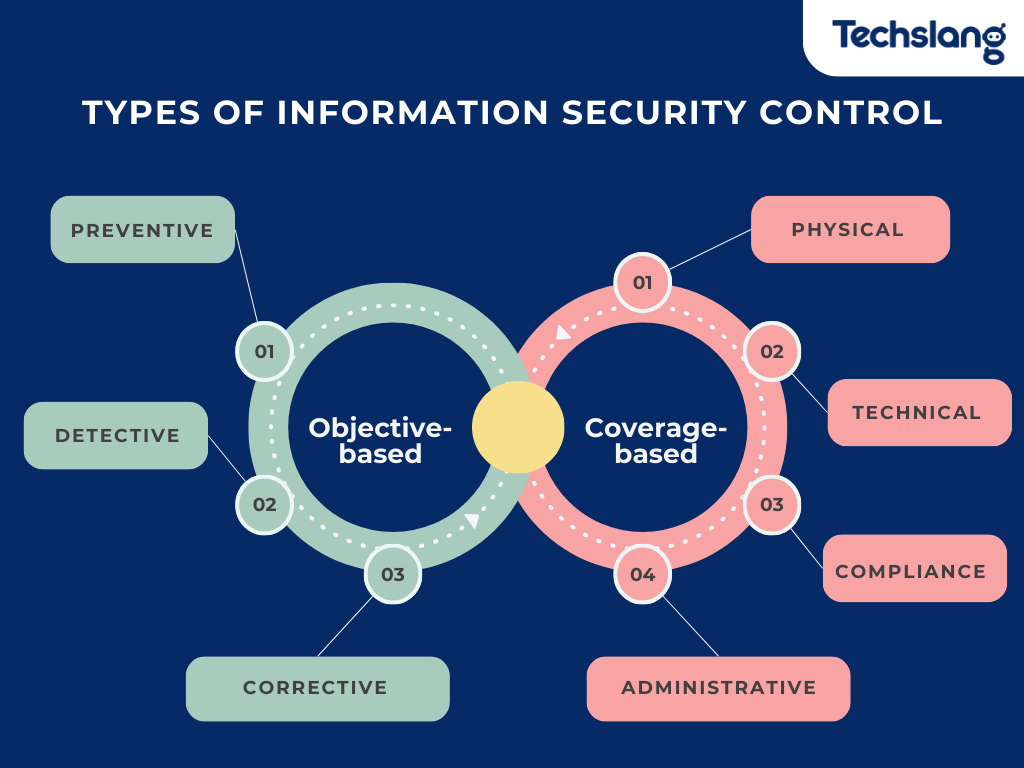
We can classify such controls based on their objectives and coverage.
Objective-Based Information Security Control
A control can be preventive, detective, or corrective. Preventive controls are designed to prevent cyber attacks from occurring in the first place. Some examples are access controls like passwords and biometrics, encryption, attack surface management (ASM) platforms, and intrusion prevention systems (IPSs).
Meanwhile, detective controls aim to identify security incidents after they occur, although the best practice is still to detect incidents early to minimize their impact. Organizations may employ vulnerability scanners and intrusion detection systems (IDSs) as detective controls.
Cybersecurity controls can also be corrective, allowing organizations to quickly remediate security incidents after they are detected. Some examples are incident response and disaster recovery plans.
Coverage-Based Information Security Control
The controls can also be categorized based on their scope. Physical controls, for instance, help ensure that physical access to data and information systems is well-guarded.
On the other hand, technical controls encompass solutions and any application used to fight against cyber threats. Some of the items we mentioned under objective-based controls, such as encryption, ASM, IPSs, and IDSs, can fall under technical control.
Security controls can also be administrative, such as the incident response and disaster recovery plans mentioned earlier. Information security awareness training is also an administrative type of cybersecurity control.
Lastly, some legislation and standards dictate how organizations implement security controls. These fall under compliance controls. For instance, the National Institute of Standards and Technology (NIST) has a cybersecurity framework that includes a catalog of individual controls that can be used to address specific risks.
What Is the Goal of Information Security Control ?
The primary objective of security controls is to protect data and systems from cyber threats and ensure their confidentiality, integrity, and availability.
—
All organizations, regardless of size or industry, need to have cybersecurity controls in place since the risks of a data breach or cyber attack can lead to financial loss, reputational damage, and legal consequences.
Key Takeaways
- An information security control is any software, hardware, policy, or procedure designed to prevent, detect, and address data exposure risks.
- It aims to maintain the confidentiality, integrity, and availability of an organization’s information assets.
- It helps organizations manage their attack surface, comply with regulations, and ensure business continuity.
- It can be classified as objective-based, which includes preventive, detective, and corrective controls.
- It can also be coverage-based, encompassing technical, physical, administrative, and compliance controls.
Sources
- https://securityscorecard.com/blog/what-are-information-security-controls/
- https://purplesec.us/learn/security-controls/
- https://www.ibm.com/topics/security-controls
- https://reciprocity.com/resources/what-are-information-security-controls/
- https://www.bitsight.com/glossary/information-security-controls


