



Modern applications process sensitive customer data, business information, and financial transactions day in and day out, making software security a critical part of development. Finding vulnerabilities after deployment is often expensive and disruptive, which is why organizations increasingly integrate security testing throughout the development process.
Three of the most common approaches are static application security testing (SAST), dynamic application security testing (DAST), and interactive application security testing (IAST). While they share the same goal—identifying security weaknesses—they work in very different ways and provide unique advantages.
SAST, DAST, and IAST: What Are They?
SAST, DAST, and IAST are application security testing methodologies designed to identify vulnerabilities before attackers can exploit them.
- SAST: Examines an application’s source code, bytecode, or binaries without executing the program.
- DAST: Evaluates a running application by interacting with it as an external user would.
- IAST: Monitors an application while it runs and combines runtime analysis with insight into the application’s internal code execution.
Together, these approaches cover different stages of software development and provide a more complete picture of application security.
| METHOD | TESTS | REQUIRES RUNNING APPLICATION? | TYPICAL STAGE |
| SAST | Source code | No | Development |
| DAST | Running application | Yes | Testing or staging |
| IAST | Running application with instrumentation | Yes | Functional testing |
What Is SAST?
SAST is a white box testing method that analyzes an application’s internal code for security vulnerabilities without executing it. Because it analyzes source code or compiled artifacts, it can identify issues long before the software reaches production.
Developers often integrate SAST tools into their integrated development environments (IDEs), build pipelines, or continuous integration (CI) workflows so vulnerabilities are detected automatically during development.
Unlike manual code reviews, SAST tools can scan thousands of files within minutes and consistently apply security rules across large projects.
How Does It Work?
SAST analyzes the application’s structure rather than its runtime behavior. Tools parse source code and create an internal model representing the data flow, control flow, and function relationships. They then compare this model against known security rules and vulnerability patterns. The simplified SAST workflow looks like this.
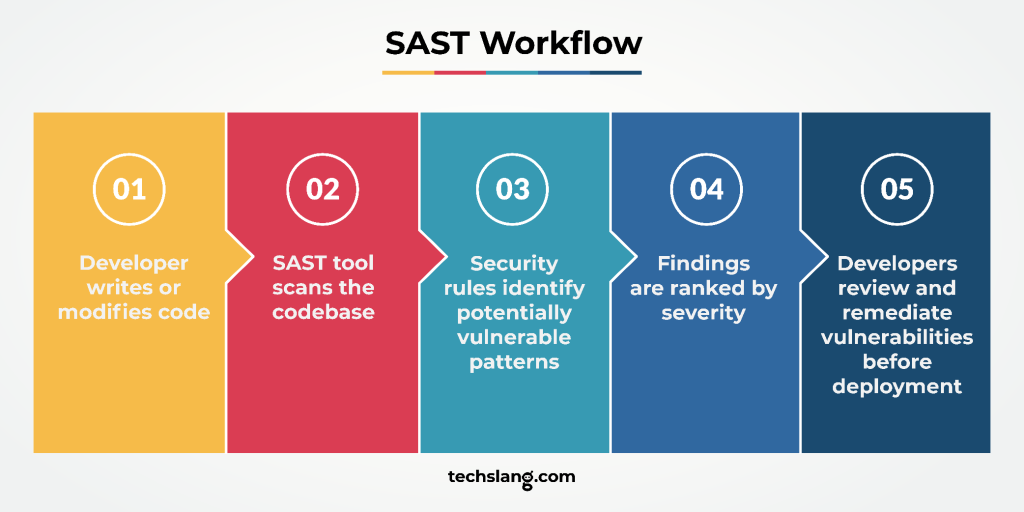
Because the application being tested never needs to run, SAST can identify vulnerabilities at the earliest stages of development.
When Do You Use It?
- Any software development team can scan source code for potential cyber issues while it’s being written. For example, a financial institution might use SAST when building an online banking portal. Every code commit automatically triggers a scan. Before new features are merged, the tool detects an insecure SQL query that could lead to SQL injection. The developer can then replace the query with parameterized statements, eliminating the vulnerability before customers ever use the application.
- A software company can use it to release updates multiple times per week. Integrating SAST into its CI/CD pipeline allows every pull request to be scanned automatically. So, instead of relying on monthly or annual security audits, vulnerabilities are identified and fixed continuously, reducing security debt over time.
- A development team can use it when integrating third-party libraries into a project. SAST can highlight unsafe coding patterns or insecure ways the application interacts with those libraries, helping developers address risks before release.
What Is DAST?
DAST evaluates an application while it runs. Unlike SAST, DAST does not analyze source code. Instead, it approaches the application like an external attacker, sending requests, manipulating inputs, and observing responses to identify exploitable vulnerabilities. This makes it a black box testing technique. Because it focuses on runtime behavior, it can discover vulnerabilities that SAST alone may miss, including configuration errors and authentication problems. The DAST workflow looks like this.
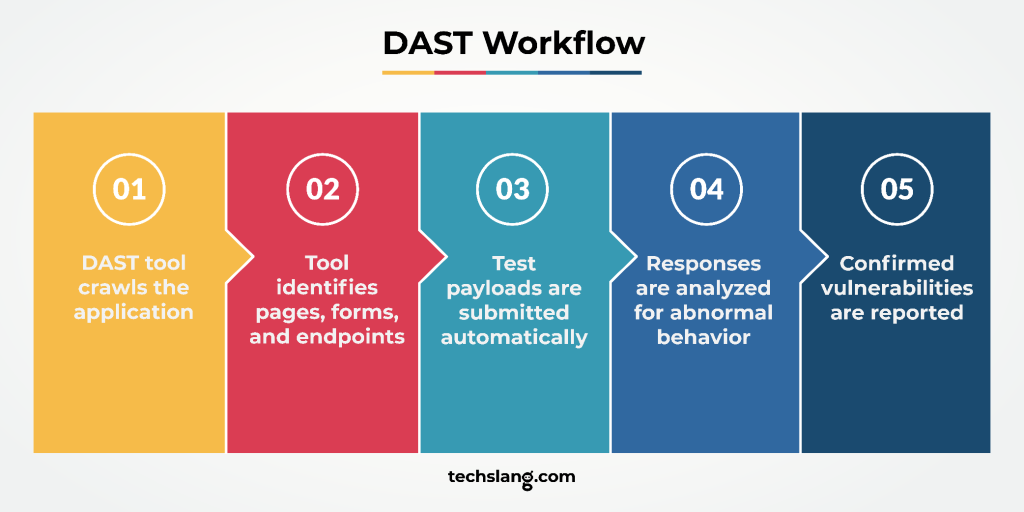
Rather than asking whether insecure code exists, DAST helps answer a practical question: Could this vulnerability be triggered through the application’s exposed interface? This makes it particularly valuable before software is released into production.
When Do You Use It?
- An e-commerce company might use it before launching a new online store, for example. The security team can run a scan against the staging environment. It then discovers that user input is reflected without proper sanitization, creating a cross-site scripting (XSS) vulnerability that could allow attackers to steal customer session cookies.
- A hospital can use it to deploy a patient portal for online appointments. DAST testing identifies that unauthorized users can access certain URLs directly without proper authentication checks, allowing developers to fix an access control issue before public release.
- A software company can use it to expose REST APIs to customers. DAST sends unexpected payloads and malformed requests to API endpoints, revealing improper input validation that attackers could otherwise exploit.
What Is IAST?
IAST combines elements of both SAST and DAST by analyzing an application from the inside while it runs. Unlike SAST that examines source code without execution or DAST that tests an application from the outside, IAST uses an agent installed within the application or application server. This agent monitors how the application processes requests, tracks data flows, and observes code execution in real time. Because it has visibility into both the application’s internal logic and its runtime behavior, IAST can often provide more accurate results with fewer false positives than traditional testing methods.
IAST is typically used during quality assurance (QA) or functional or preproduction testing, where the application is actively running and being exercised by automated or manual tests.
How Does It Work?
IAST continuously monitors an application’s execution while tests are performed. Its typical workflow looks like this.
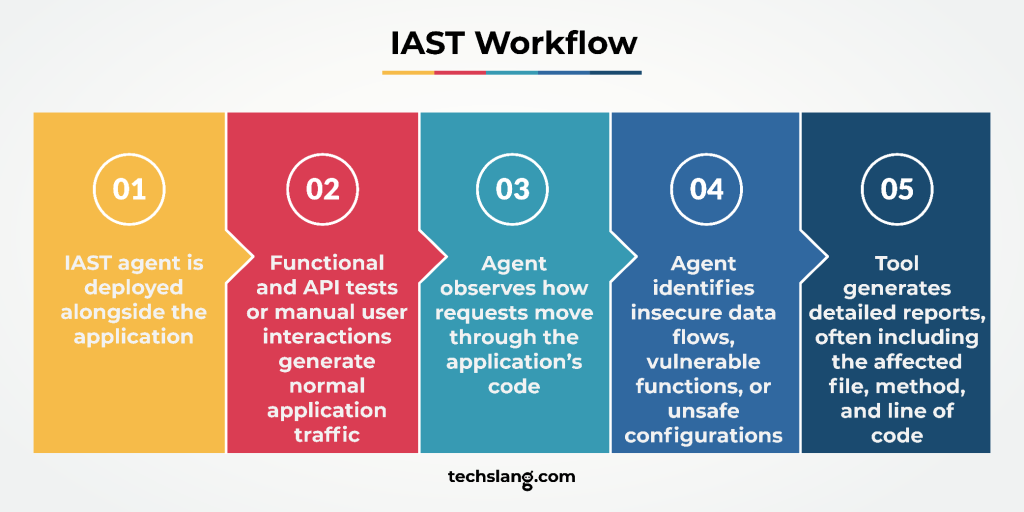
Since IAST analyzes actual application execution instead of theoretical code paths, it can distinguish between vulnerabilities that are genuinely reachable and those that are not. However, IAST may miss vulnerabilities in code paths that are not exercised during testing.
When Do You Use It?
- A large organization can use it to perform automated regression testing before every release. An agent monitors thousands of test cases and discovers that a user-supplied parameter reaches a database query without proper sanitization. The report identifies the exact method responsible, allowing developers to resolve the issue quickly.
- A software-as-a-service (SaaS) provider can integrate IAST into its automated testing environment. Every time new features are deployed to a staging server, existing functional tests generate traffic while the agent monitors execution. Vulnerabilities are detected as part of normal testing instead of requiring a separate security assessment.
- An API development team can use it when building a microservices-based application with dozens of APIs. During integration testing, IAST observes requests traveling between services and identifies an insecure deserialization flaw that would have been difficult to detect through external testing alone.
How Do SAST, DAST, and IAST Differ from One Another?
Although all three methods aim to improve application security, they answer different questions and work at different stages of the software development life cycle.
| FEATURE | SAST | DAST | IAST |
| Testing approach | Static (code analysis) | Dynamic (external testing) | Interactive (runtime + internal analysis) |
| Requires source code | Yes | No | No (but requires application instrumentation) |
| Requires running application | No | Yes | Yes |
| Best used during | Development | Staging, preproduction, or controlled production testing | QA and functional testing |
| Perspective | White box | Black box | Hybrid |
| Finds exact code location | Yes | Usually no | Yes |
| False positives * | Moderate | Lower | Generally lower |
| Detects runtime issues | No | Yes | Yes |
* False-positive rates vary by tool, configuration, framework support, and test coverage.
No single method replaces the others. SAST excels at early detection, DAST validates security from an attacker’s perspective, and IAST provides detailed insight into vulnerabilities encountered during real application execution.
Should Organizations Use SAST, DAST, and IAST Together?
SAST, DAST, and IAST are most effective when used as complementary security testing methods rather than standalone solutions. Each examines an application from a different perspective, allowing organizations to identify vulnerabilities throughout the software development life cycle.
A common workflow looks like this:
- During development: Developers use SAST to scan source code as they write it, catching insecure coding patterns before they become part of the application.
- During testing: IAST monitors the running application while automated or manual functional tests are performed, identifying vulnerabilities that are actually executed and providing precise remediation guidance.
- Before release or in staging: DAST simulates attacks against the deployed application to uncover runtime vulnerabilities, misconfigurations, and authentication or session management issues from an external perspective.
This layered approach provides broader security coverage than any single testing method alone. For example, SAST may detect an unsafe database query early in development, IAST can confirm that the vulnerable code path is executed during testing, and DAST can verify if the issue is exploitable through the application’s public interface.
Organizations adopting DevSecOps practices often automate all three methods within their CI/CD pipelines. Every code commit triggers a SAST scan, every test environment runs IAST during functional testing, and every release candidate undergoes DAST before deployment. This continuous feedback loop helps teams fix vulnerabilities earlier, reduce remediation costs, and improve overall software quality.
Conclusion
SAST, DAST, and IAST each provide a different perspective on application security. SAST identifies vulnerabilities directly in source code, DAST evaluates applications from an attacker’s viewpoint, and IAST combines runtime analysis with internal visibility for deeper insight.
Rather than choosing one approach, organizations gain the greatest protection by using all three throughout the software development life cycle. Together, they help developers detect vulnerabilities earlier, validate real-world risks, and deliver more secure applications without slowing down innovation.